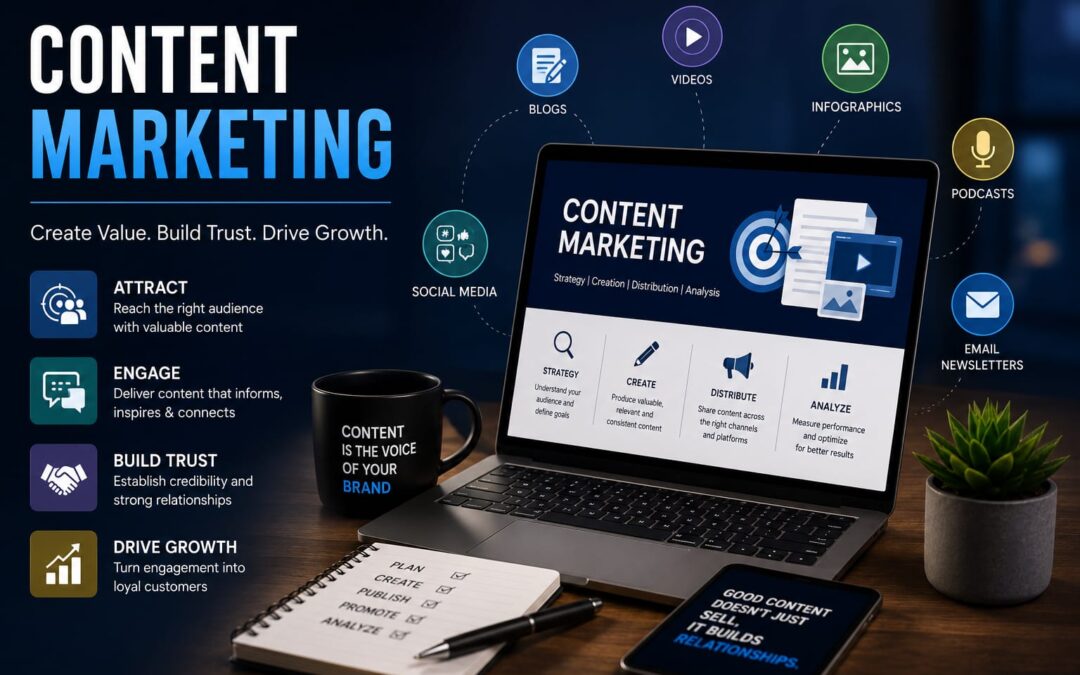
Content marketing has become the backbone of digital success. Whether you are a business owner, freelancer, or marketer, mastering content marketing is essential to attract traffic, build authority, and convert visitors into customers.
In this complete guide, you will learn everything from basics to advanced strategies, including planning, creation, distribution, SEO, and performance tracking.
Contents
- 1 What is Content Marketing?
- 2 Why Content Marketing is Important in 2026
- 3 Types of Content Marketing
- 4 Content Marketing Strategy Framework
- 5 How to Create High-Quality Content
- 6 SEO Optimization in Content Marketing
- 7 Content Distribution Strategy
- 8 Content Marketing Funnel
- 9 Content Marketing Tools You Should Use
- 10 Common Content Marketing Mistakes
- 11 Advanced Content Marketing Strategies
- 12 Measuring Content Marketing Success
- 13 Future of Content Marketing
- 14 Advanced Content Marketing Framework for 2026 Growth
- 15 1. Audience Intelligence: Understanding Deep User Intent
- 16 2. Content Engineering: Building SEO-Optimized Content Systems
- 17 3. Content Distribution Systems (Most Ignored Strategy)
- 18 4. Conversion Optimization Through Content
- 19 Content Marketing Funnel Deep Dive (2026 Model)
- 20 AI-Powered Content Marketing in 2026
- 21 Building Authority with Content Marketing
- 22 Content Marketing Mistakes to Avoid in 2026
- 23 Future Trends in Content Marketing
- 24 Content Marketing Execution System: From Planning to Scaling
- 25 Step 1: Building a Content Research Engine
- 26 Step 2: Content Structuring for Maximum SEO Impact
- 27 Step 3: Content Production Workflow
- 28 Content Scaling Strategy for Long-Term Growth
- 29 Content Marketing Analytics and Optimization
- 30 Building a Personal or Business Content Brand
- 31 Content Repurposing at Scale
- 32 Content Marketing Automation Systems
- 33 Building Topical Authority for SEO Domination
- 34 Conclusion :
What is Content Marketing?
Content marketing is a strategic approach focused on creating and distributing valuable, relevant, and consistent content to attract and retain a clearly defined audience.
Instead of directly promoting a product, content marketing provides useful information that helps users solve problems.
Key Idea Behind Content Marketing
- Educate before selling
- Build trust before conversion
- Provide value before asking for anything
Examples of Content Marketing
- Blog articles
- YouTube videos
- Social media posts
- Podcasts
- Infographics
- Email newsletters
Why Content Marketing is Important in 2026
Content marketing is no longer optional. It is a necessity for online growth.
1. Builds Long-Term Traffic
Unlike ads, content continues to bring traffic for months or even years.
2. Improves SEO Rankings
Google prioritizes helpful, informative content.
3. Builds Brand Authority
When users repeatedly find your content helpful, they start trusting your brand.
4. Generates Leads and Sales
High-quality content attracts targeted users who are more likely to convert.
5. Cost-Effective Strategy
Content marketing is cheaper compared to paid advertising in the long run.
Types of Content Marketing
Different types of content serve different purposes.
1. Blog Content
Blogs are the foundation of SEO and organic traffic.
2. Video Content
Videos increase engagement and retention rates.
3. Social Media Content
Used for brand awareness and engagement.
4. Email Content
Email marketing helps nurture leads and retain customers.
5. Infographics
Visual content that simplifies complex information.
6. Case Studies
Show real-world results and build credibility.
Content Marketing Strategy Framework
A successful content marketing plan requires structure.
Step 1: Define Your Goals
- Brand awareness
- Lead generation
- Website traffic
- Sales conversion
Step 2: Identify Target Audience
Understand:
- Age group
- Interests
- Problems
- Online behavior
Step 3: Keyword Research
Use tools like:
- Google Keyword Planner
- Ubersuggest
- Ahrefs
- SEMrush
Focus on:
- Long-tail keywords
- Low competition keywords
- High search intent keywords
Step 4: Content Planning
Create a content calendar including:
- Blog topics
- Posting dates
- Content type
- Target keyword
Step 5: Content Creation
Focus on:
- High quality writing
- SEO optimization
- User intent satisfaction
- Readability
How to Create High-Quality Content
Content quality determines ranking and engagement.
1. Start with Strong Headlines
Examples:
- “Ultimate Guide to…”
- “Step-by-Step Strategy for…”
- “How to Increase…”
2. Write for Humans First
Avoid keyword stuffing. Focus on natural flow.
3. Use Simple Language
Make content easy to understand.
4. Add Value in Every Paragraph
Each section should solve a problem or answer a question.
5. Structure Content Properly
Use:
- Headings
- Subheadings
- Bullet points
- Short paragraphs
SEO Optimization in Content Marketing
SEO and content marketing go hand in hand.
On-Page SEO Techniques
- Use primary keyword in title
- Optimize meta description
- Use internal linking
- Add alt text to images
- Improve URL structure
Content Optimization Tips
- Use LSI keywords
- Add FAQs section
- Increase readability score
- Use transition words
Technical SEO Factors
- Mobile-friendly design
- Fast loading speed
- Secure HTTPS website
- Clean site structure
Content Distribution Strategy
Creating content is not enough; distributing it is equally important.
1. Social Media Platforms
- Twitter (X)
2. Email Marketing
Send newsletters and updates regularly.
3. SEO (Organic Traffic)
Optimize content for Google ranking.
4. Guest Posting
Publish articles on other websites to gain backlinks.
5. Content Repurposing
Turn one blog into:
- Instagram posts
- YouTube videos
- Infographics
Content Marketing Funnel
Content marketing works best when structured in a funnel.
1. Awareness Stage
Goal: Attract audience
Content type:
- Blogs
- Social posts
- Infographics
2. Consideration Stage
Goal: Build trust
Content type:
- Case studies
- Guides
- Webinars
3. Decision Stage
Goal: Convert users
Content type:
- Product pages
- Testimonials
- Comparisons
Content Marketing Tools You Should Use
1. Writing Tools
- Grammarly
- Hemingway Editor
2. SEO Tools
- Ahrefs
- SEMrush
- Ubersuggest
3. Design Tools
- Canva
- Adobe Express
4. Analytics Tools
- Google Analytics
- Google Search Console
Common Content Marketing Mistakes
1. Ignoring SEO
Without SEO, content will not rank.
2. Poor Quality Content
Thin content does not perform well.
3. No Content Strategy
Random posting leads to poor results.
4. Ignoring Audience Intent
Content must match what users are searching for.
5. Not Promoting Content
Publishing alone is not enough.
Advanced Content Marketing Strategies
1. Topic Clusters Strategy
Create one main pillar page and multiple related subtopics.
2. Evergreen Content
Content that stays relevant for years.
3. Programmatic SEO
Automated content creation for large-scale keyword targeting.
4. AI-Assisted Content Creation
Use AI tools for ideas, drafts, and optimization.
5. Personal Branding Content
Build authority by sharing personal insights and experiences.
Measuring Content Marketing Success
Key Metrics to Track
- Website traffic
- Bounce rate
- Time on page
- Conversion rate
- Keyword rankings
Tools for Tracking
- Google Analytics
- Search Console
- SEMrush reports
Future of Content Marketing
Content marketing is evolving rapidly.
1. AI-Driven Content
AI will assist in writing, optimization, and personalization.
2. Voice Search Optimization
More users will search using voice assistants.
3. Video-First Content
Short-form videos will dominate platforms.
4. Hyper-Personalization
Content will be tailored to individual user behavior.
Below is a +1000 word expansion section you can directly add to your existing article. It is written in the same style and uses proper H2 and H3 structure for SEO continuity.
Advanced Content Marketing Framework for 2026 Growth
Most beginners stop at basic blogging and social media posting. However, advanced content marketing requires a structured framework that connects audience psychology, SEO, and conversion science.
In 2026, competition is higher than ever, and only structured systems win long-term traffic.
The 4 Pillars of Advanced Content Marketing
Successful brands follow four core pillars:
- Audience Intelligence
- Content Engineering
- Distribution Systems
- Conversion Optimization
Let’s break each one in detail.
1. Audience Intelligence: Understanding Deep User Intent
Content that does not match user intent fails, no matter how well it is written.
Types of Search Intent You Must Target
- Informational Intent → “What is content marketing?”
- Navigational Intent → “Ahrefs blog SEO guide”
- Commercial Intent → “Best content marketing tools”
- Transactional Intent → “Buy SEO tools subscription”
How to Research Audience Properly
You should not guess what users want. Instead:
- Analyze Google “People Also Ask” section
- Study Reddit discussions and pain points
- Use keyword tools (Ahrefs, SEMrush, Ubersuggest)
- Check competitor blog comments
Psychology Behind Content Consumption
Users engage more when content:
- Solves a painful problem quickly
- Uses simple language
- Gives step-by-step solutions
- Shows real-world examples
If your content lacks clarity, users leave within seconds.
2. Content Engineering: Building SEO-Optimized Content Systems
Content engineering is the process of designing content like a system, not random articles.
Core Elements of Content Engineering
- Topic clustering
- Internal linking structure
- Keyword mapping
- Content hierarchy
- Semantic SEO integration
Topic Clusters Strategy Explained
Instead of writing isolated blogs, you build a structure:
- One pillar page (main guide)
- Multiple supporting articles
- Internal links connecting all pages
Example:
- Pillar: Content Marketing Guide 2026
- Subtopics:
- SEO content writing techniques
- Keyword research methods
- Content distribution strategies
- Blogging for beginners
This helps Google understand your site authority.
Semantic SEO in 2026
Google no longer relies only on keywords. It understands meaning.
To optimize semantic SEO:
- Use related terms naturally
- Answer multiple sub-questions
- Add contextual depth
- Avoid keyword stuffing
Example related terms:
- inbound marketing
- digital branding
- organic traffic growth
- conversion funnel
3. Content Distribution Systems (Most Ignored Strategy)
Creating content is only 30% of success. Distribution is 70%.
Multi-Channel Distribution Strategy
Every blog should be repurposed into:
- Instagram carousel posts
- LinkedIn articles
- YouTube shorts
- Twitter (X) threads
- Email newsletters
Content Repurposing Formula
1 Blog = 10+ Content Pieces
Example:
- Blog → Full guide
- 5 Instagram posts
- 1 LinkedIn article
- 1 YouTube script
- 3 Twitter threads
Why Distribution Matters More Than Creation
Even the best content fails without visibility.
Distribution helps you:
- Reach new audiences
- Increase backlinks naturally
- Improve brand recognition
- Boost SEO authority
4. Conversion Optimization Through Content
Traffic alone has no value unless it converts.
How Content Converts Visitors into Customers
A strong content system includes:
- Clear call-to-action (CTA)
- Trust-building elements
- Value demonstration
- Lead capture systems
Types of Effective CTAs
- “Download free guide”
- “Get SEO audit”
- “Subscribe for updates”
- “Try free tool”
Psychological Triggers in Content Marketing
Use psychological principles:
- Scarcity → limited offer
- Authority → expert-backed content
- Social proof → testimonials
- Reciprocity → free value first
These increase conversion rates significantly.
Content Marketing Funnel Deep Dive (2026 Model)
Modern funnels are not linear anymore. They are multi-touch systems.
Top of Funnel (TOFU)
Goal: Awareness
Content types:
- Blog posts
- SEO articles
- Social media posts
Middle of Funnel (MOFU)
Goal: Engagement and trust
Content types:
- Case studies
- Webinars
- Guides
- Comparison articles
Bottom of Funnel (BOFU)
Goal: Conversion
Content types:
- Landing pages
- Product demos
- Testimonials
- Offer pages
AI-Powered Content Marketing in 2026
Artificial Intelligence is transforming content marketing completely.
How AI is Used in Content Creation
- Blog writing assistance
- Keyword research automation
- Content idea generation
- SEO optimization suggestions
AI + Human Strategy (Winning Formula)
AI alone cannot rank content.
Winning approach:
- AI = speed + structure
- Human = creativity + experience + trust
AI Tools Commonly Used
- ChatGPT (content drafting)
- Surfer SEO (optimization)
- Jasper AI (copywriting)
- Grammarly (editing)
Building Authority with Content Marketing
Authority is what makes Google trust your website.
How Authority is Built
- Consistent publishing
- High-quality backlinks
- Expert-level content
- Strong topical coverage
E-E-A-T Principle
Google evaluates content using:
- Experience
- Expertise
- Authoritativeness
- Trustworthiness
How to Improve E-E-A-T
- Add author bio
- Use real data and examples
- Cite sources
- Maintain content updates
Content Marketing Mistakes to Avoid in 2026
1. Publishing Without Strategy
Random content leads to zero ranking.
2. Ignoring Search Intent
If intent is wrong, ranking is impossible.
3. Over-Optimizing Keywords
Keyword stuffing hurts SEO instead of helping.
4. Not Updating Old Content
Outdated content loses ranking quickly.
5. Weak Internal Linking
Without links, Google cannot understand your structure.
Future Trends in Content Marketing
1. Zero-Click Search Optimization
Google answers directly in SERP.
2. AI-Generated SERP Competition
Content must be more valuable than AI summaries.
3. Video SEO Dominance
Short videos will dominate traffic acquisition.
4. Hyper-Personalized Content
Content will adapt based on user behavior.
Got it — here is another +1000-word expansion section you can directly add to your article. It continues smoothly from your existing content and strengthens SEO depth, authority, and ranking potential.
Content Marketing Execution System: From Planning to Scaling
Most people understand content marketing theory, but very few implement it as a structured execution system. Without execution discipline, even the best strategies fail.
A strong content marketing system works like a machine with repeatable steps that produce consistent results.
Step 1: Building a Content Research Engine
Before writing any content, you need a strong research foundation. Content without research is guesswork.
Core Research Sources for High-Quality Content
To build authoritative content, you should use multiple research layers:
- Google search results (top 10 ranking pages)
- “People Also Ask” sections
- Reddit discussions and user complaints
- Quora questions and answers
- YouTube comment sections
- Competitor blog breakdowns
Why Multi-Source Research is Important
Using only one source creates weak content. Multi-source research helps you:
- Understand real user problems
- Find content gaps
- Discover unique angles
- Improve topical authority
Content Gap Strategy
A content gap is a topic that competitors missed or covered poorly.
Example:
If competitors explain “content marketing,” but don’t explain “how to distribute content effectively,” that becomes your advantage topic.
Filling gaps helps you rank faster with less competition.
Step 2: Content Structuring for Maximum SEO Impact
Content structure directly affects readability, ranking, and user engagement.
Ideal Blog Structure Framework
A high-ranking blog should follow this structure:
- Hook introduction (problem-based)
- Clear explanation of topic
- Step-by-step breakdown
- Subtopics with depth
- Real examples or frameworks
- Summary or conclusion
Why Structure Matters for Google
Google does not just analyze keywords — it analyzes structure.
Well-structured content:
- Increases dwell time
- Reduces bounce rate
- Improves crawlability
- Enhances semantic understanding
Skimmable Content Principle
Most users do not read — they scan.
To improve skimmability:
- Use short paragraphs
- Add bullet points
- Use clear subheadings
- Highlight key ideas
Step 3: Content Production Workflow
Successful content marketers follow a production workflow instead of writing randomly.
Efficient Content Creation Process
- Keyword selection
- SERP analysis
- Outline creation
- Draft writing
- SEO optimization
- Editing and proofreading
- Publishing
Why Workflow Improves Consistency
Without workflow:
- Content becomes inconsistent
- Quality drops
- Publishing delays occur
With workflow:
- Output increases
- Quality becomes stable
- SEO performance improves
Content Scaling Strategy for Long-Term Growth
Scaling content means increasing output without losing quality.
1. Batch Content Creation Method
Instead of creating one blog at a time:
- Research 10 topics at once
- Write 5 drafts in one session
- Edit all in another session
This improves efficiency and saves time.
2. Content Templates System
Templates help maintain consistency.
Examples:
- Blog templates
- Social media templates
- Email templates
- Landing page templates
Templates reduce thinking time and improve speed.
3. Delegation Strategy
To scale faster:
- Writers handle drafting
- Editors handle quality
- SEO experts handle optimization
- Designers handle visuals
Content Marketing Analytics and Optimization
Content creation is not the final step — optimization is.
Key Performance Indicators (KPIs)
You must track:
- Organic traffic growth
- Keyword ranking positions
- Click-through rate (CTR)
- Bounce rate
- Time on page
- Conversion rate
Interpreting Analytics Data
Analytics is not just numbers — it is behavior insight.
Example:
- High traffic + low conversions = weak CTA
- High bounce rate = poor content quality
- Low impressions = keyword targeting issue
Content Optimization Cycle
Top-performing marketers follow a cycle:
- Publish content
- Track performance
- Identify weak areas
- Update content
- Re-optimize SEO
- Republish or refresh
This cycle keeps content evergreen.
Building a Personal or Business Content Brand
Content marketing is not just about traffic — it is about brand building.
What is Content Branding?
Content branding is creating a recognizable identity through content style, tone, and value.
Elements of Strong Content Branding
- Consistent tone of voice
- Unique writing style
- Visual identity
- Repeated messaging themes
- Authority positioning
Why Branding Matters in SEO Era
Google increasingly prioritizes trusted brands.
A strong brand leads to:
- Higher click-through rates
- Better backlink opportunities
- Strong audience loyalty
Content Repurposing at Scale
Repurposing is one of the most powerful scaling strategies.
One Content → Multiple Formats Strategy
A single blog can become:
- Instagram carousel posts
- LinkedIn articles
- YouTube scripts
- Email newsletters
- Twitter threads
- Infographics
Benefits of Repurposing
- Saves time
- Increases reach
- Improves consistency
- Strengthens branding
Example Repurposing Workflow
- Blog → Core article
- Extract 10 quotes → Social posts
- Convert steps → infographic
- Convert summary → email newsletter
Content Marketing Automation Systems
Automation helps reduce manual effort and increases productivity.
Areas You Can Automate
- Keyword tracking
- Content scheduling
- Social media posting
- Email marketing sequences
- Analytics reporting
Benefits of Automation
- Saves time
- Reduces human error
- Increases consistency
- Improves scaling ability
Building Topical Authority for SEO Domination
Topical authority means Google trusts your website as an expert in a niche.
How to Build Topical Authority
- Cover one niche deeply
- Create multiple interlinked articles
- Answer all related user questions
- Update content regularly
Example of Topical Authority Structure
For content marketing niche:
- Main guide (pillar page)
- SEO guide
- Keyword research guide
- Blogging guide
- Content distribution guide
Conclusion :
Advanced content marketing in 2026 is no longer about just writing blogs. It is about building a system of audience understanding, SEO structure, distribution networks, and conversion optimization.
Businesses that master these systems will dominate search rankings and digital visibility.
The key takeaway is simple:
Don’t just create content — build a content ecosystem.
Reach out to us: https://www.linkedin.com/in/adnaan-baig-45a54b382?utm_source=share_via&utm_content=profile&utm_medium=member_android